Many beginners think only dofollow links matter. In reality, a healthy website profile includes both types. Let’s break this down in simple terms so you can clearly see how each link type works and when to use them.
Quick Overview of Link Types
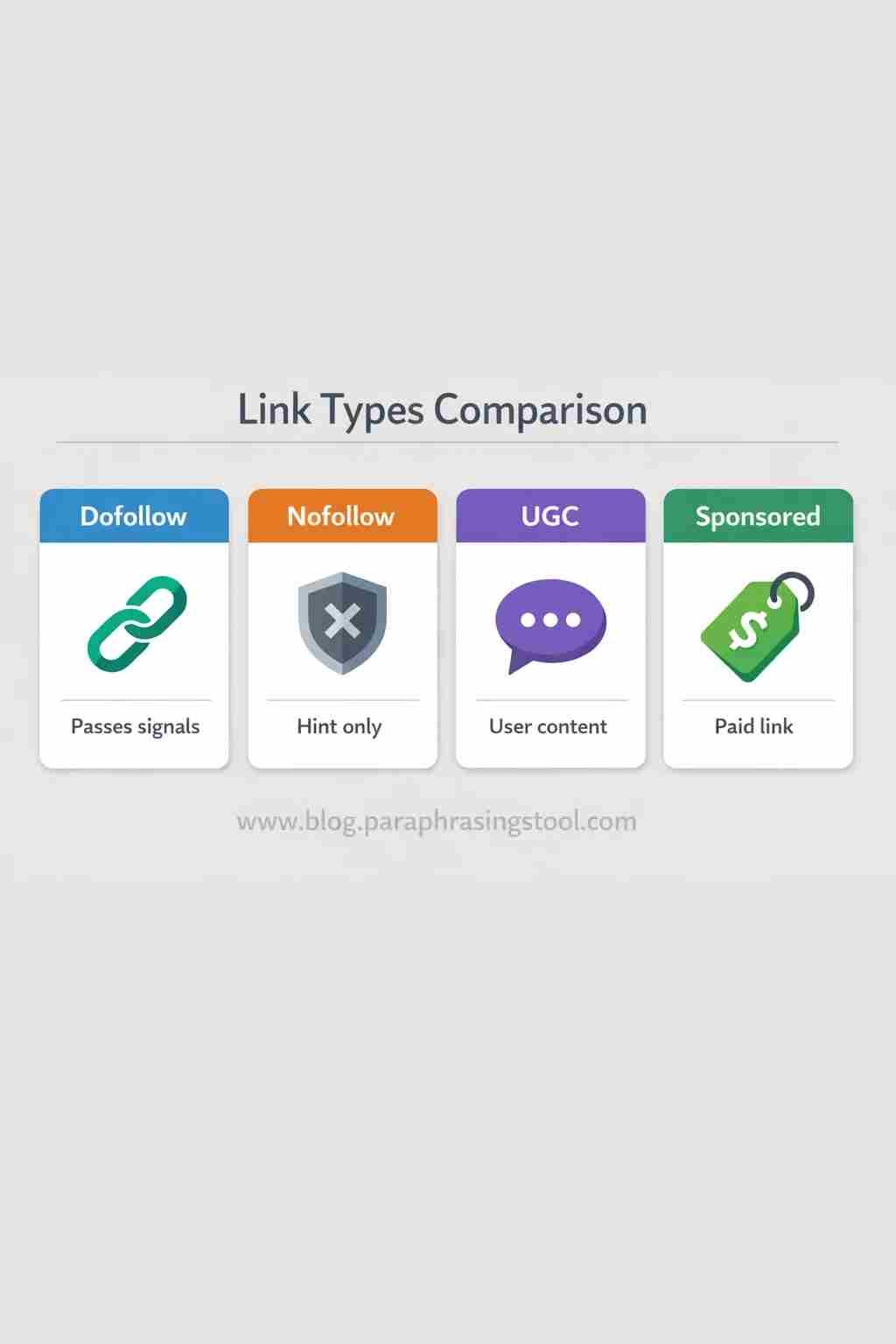
| Link Type | Main Purpose | Passes SEO Authority | Common Use Case |
|---|---|---|---|
| Dofollow | Transfers ranking signals | Yes | Editorial links, references |
| Nofollow | Suggests search engines not to pass authority | Limited / Hint | Comments, untrusted links |
| UGC | Indicates user-generated content | Usually no | Forums, comments |
| Sponsored | Indicates paid links | No | Ads, affiliate links |
This table shows the basic structure search engines use to understand links across the web.
Dofollow vs Nofollow Links Explained
Links are signals that help search engines discover and rank pages. But not every link carries the same weight.
What Is a Dofollow Link
A dofollow link is the default type of hyperlink. It allows search engines to follow the link and pass ranking authority from one page to another.
When a website links to your content using a dofollow link, search engines treat it as a vote of confidence.
Example HTML:
Since there is no special attribute attached, the link is automatically considered dofollow.
This means search engines can:
- Crawl the destination page
- Transfer ranking signals
- Use the link as part of their ranking algorithms
Because of this, dofollow links are often considered the most valuable backlinks for SEO.
What Is a Nofollow Link
A nofollow link contains an attribute that tells search engines not to pass authority to the destination page.
Example HTML:
This attribute was introduced to prevent spam and manipulation in blog comments and forums.
Search engines may still crawl the link, but they typically do not transfer ranking power.
However, modern search engines treat nofollow links as a hint rather than a strict rule, meaning they might still consider them in some contexts.
The Real Difference That Affects Rankings
When people compare dofollow vs nofollow links, they usually focus on authority. But ranking impact actually depends on several factors.
Dofollow links
These links pass authority from the linking page to the destination page.
They help improve:
- Page authority
- Domain authority signals
- Search rankings
- Crawl discovery
A single dofollow link from a strong site can be extremely powerful.
Nofollow links
Nofollow links usually do not transfer ranking signals.
However, they still provide value because they can:
- Send traffic to your site
- Increase brand visibility
- Help search engines discover new pages
- Diversify your backlink profile
So even though they are weaker for rankings, they are still useful in an SEO strategy.
How to Check If a Link Is Dofollow or Nofollow
Many people ask: How do I know if a link is dofollow?
There are several simple ways to check.
Method 1: Inspect the link
Right-click on a webpage and choose Inspect in your browser.
Look for the HTML code of the link.
If you see:
then the link is nofollow.
If the attribute is missing, the link is dofollow.
Method 2: Use browser extensions
Several SEO tools highlight link types automatically.
Popular options include:
- SEO Minion
- MozBar
- Ahrefs toolbar
These tools color-code links so you can instantly see whether they are dofollow or nofollow.
Method 3: Use SEO analysis tools
Advanced tools such as:
- Ahrefs
- SEMrush
- Majestic
can analyze entire websites and show the percentage of dofollow vs nofollow backlinks.
This helps you understand your overall link profile.
Which Backlink Is Most Powerful
The truth is simple: the strongest backlink is not always just dofollow.
The real power of a link depends on three main factors.
Relevance
A link from a website in your niche is far more valuable than a random link from an unrelated site.
For example:
- A technology blog linking to your AI article
- A medical website linking to health research
Relevance increases the trust of the link.
Authority
Links from high-authority websites carry more weight.
Examples include:
- Major news websites
- Government websites
- Established industry blogs
These links send strong credibility signals.
Placement
Where the link appears also matters.
Best placements include:
- Editorial links inside articles
- Contextual links within relevant paragraphs
Less powerful placements include:
- Footer links
- Sidebar links
- Profile links
Does Nofollow Help SEO
Many beginners think nofollow links are useless.
That’s not true.
Nofollow links help SEO indirectly.
They can bring:
- Referral traffic
- Brand recognition
- Natural link diversity
- Discovery signals for search engines
Search engines expect a natural mix of link types.
If every backlink pointing to your site is dofollow, it may look suspicious.
A healthy profile usually includes:
- Editorial dofollow links
- Social media links
- Forum links
- Blog comment links
This balanced structure signals authenticity.
When to Use Nofollow Links
Website owners often ask when they should apply the nofollow attribute.
There are several situations where it is recommended.
Sponsored or paid links
If a link is part of advertising, it should be labeled with a sponsored or nofollow attribute.
This prevents manipulation of search rankings.
User-generated content
Links placed by users should often be marked as nofollow or UGC.
Examples include:
- Blog comments
- Forum posts
- User profiles
This protects the website from spam.
Links you cannot verify
If you cannot fully trust the destination website, using nofollow is a safer option.
This tells search engines you are not endorsing the linked page.
Are Nofollow Backlinks Bad
No.
Nofollow backlinks are not harmful.
In fact, they are a natural part of the internet.
Many large platforms automatically apply nofollow to outbound links.
Examples include:
- Wikipedia
- Quora
- YouTube
Even though these links do not pass authority, they can generate large amounts of traffic.
For many websites, a viral link from these platforms can bring thousands of visitors.
Are Medium Links Dofollow
The blogging platform Medium generally uses nofollow attributes on outbound links.
This means links placed in Medium articles usually do not pass ranking authority.
However, they still offer benefits:
- Exposure to Medium readers
- Brand awareness
- Traffic from article recommendations
Because of Medium’s strong domain authority, even a nofollow link can still be valuable.
How to Get More Dofollow Links
Building dofollow backlinks should focus on quality, not quantity.
Here are some proven strategies.
Create link-worthy content
The best backlinks come from content that people naturally want to reference.
Examples include:
- Detailed guides
- Research studies
- Original data
- Infographics
High-quality content attracts organic links.
Guest blogging
Writing articles for other websites is one of the most common link-building strategies.
Choose reputable blogs in your niche and provide helpful content.
In return, you often receive a dofollow backlink in the author bio or article.
Digital PR
Getting featured in news stories, interviews, or expert roundups can earn powerful editorial links.
These links often come from high-authority websites.
Resource page outreach
Many websites maintain resource pages listing useful tools or guides.
If your content fits their topic, you can request inclusion.
This often results in a dofollow link.
What Are the Three Types of Backlinks
Backlinks generally fall into three major categories.
Editorial backlinks
These are links naturally placed within content by the website owner.
They are the most valuable because they represent genuine recommendations.
Guest post backlinks
These links appear in articles you publish on other websites.
They are commonly used in content marketing.
Directory or profile backlinks
These come from profile pages, business listings, or directories.
They are easy to obtain but usually weaker.
What Are the Four Pillars of SEO
Successful SEO strategies rely on four core elements.
Technical SEO
This focuses on how search engines crawl and index your website.
Examples include:
- Site speed
- Mobile optimization
- Structured data
- Clean site architecture
Content
Content answers user questions and provides value.
Search engines prioritize helpful, well-structured content.
Authority
Authority is largely built through backlinks and brand mentions.
High-quality backlinks signal trust.
User experience
A positive user experience improves engagement and rankings.
Important factors include:
- Page loading speed
- Easy navigation
- Clear layout
Which URL Structure Is Best for SEO
Search engines prefer URLs that are simple and descriptive.
A good SEO-friendly URL usually has these features:
- Short and readable
- Includes the main keyword
- Uses hyphens instead of underscores
- Avoids unnecessary numbers or parameters
Example:
Good URL
Bad URL
Clean URLs help both users and search engines understand the page.
Common Mistakes People Make With Backlinks
Many websites unintentionally weaken their SEO strategy by making simple mistakes.
Some of the most common include:
Chasing only dofollow links
Focusing only on dofollow links can make your backlink profile look unnatural.
Search engines expect a mix.
Buying low-quality backlinks
Cheap backlink packages often come from spam networks.
These links can harm rankings instead of improving them.
Ignoring relevance
A relevant link from a small niche blog is often stronger than a random link from a large unrelated site.
Final Thoughts
Understanding dofollow vs nofollow links is one of the foundations of SEO.
Dofollow links pass authority and help improve rankings.
Nofollow links usually do not transfer authority but still provide traffic, visibility, and natural link diversity.
The most successful websites focus on earning high-quality editorial links while maintaining a natural mix of link types.
Instead of chasing hundreds of backlinks, focus on building useful content and genuine relationships within your niche. Over time, the right links will follow naturally.

Alex WebPro, your guide to web mastery. Expert tips on WordPress, SEO, monetization, and the best in design trends and themes.